

Programmes
Events
As an automotive engineer you work on vehicles and on everything inside them. Your job is to make those separate parts work as one.
Four in five graduates go into the automotive industry: at truck and car manufacturers, suppliers and engineering firms, most of them in and around Brainport Eindhoven. The fifth usually moves into high tech. And many students stay on at the company where they graduated.
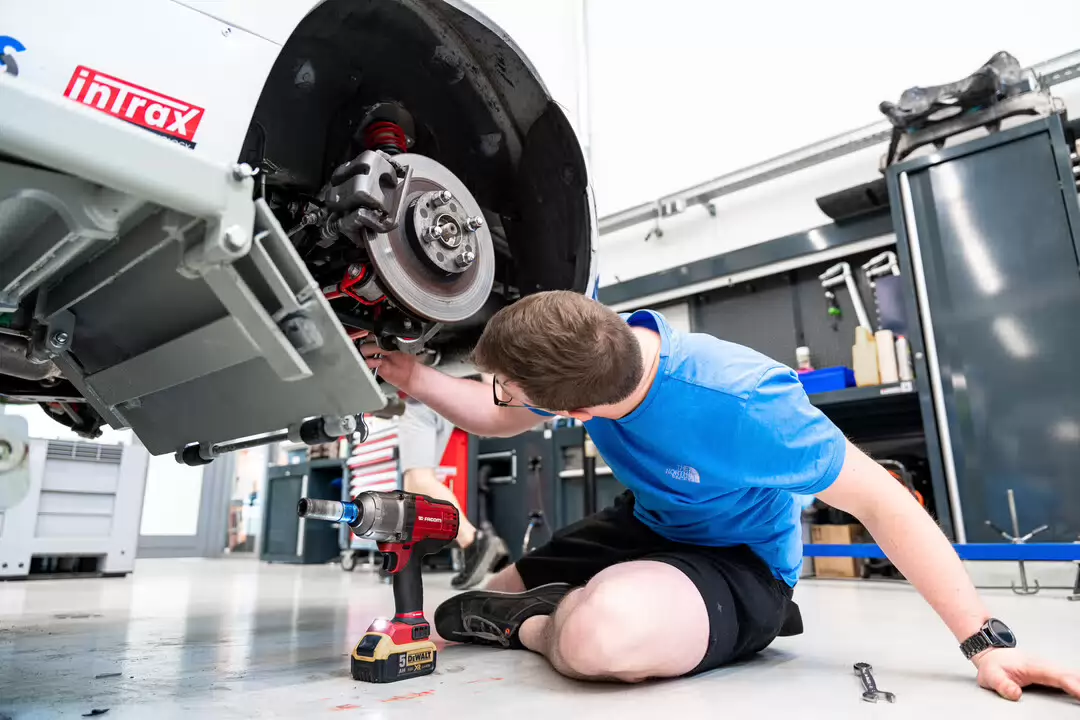
After graduation you can start your career as a:
You design the parts a vehicle literally runs on: chassis, suspension, drive shafts. You calculate whether they are strong enough and choose the material, lighter every time, because every kilo counts. Graduates work at DAF Trucks, Nooteboom Trailers, VB-Airsuspension and JT-Performance.
You work on everything in a vehicle that carries current or a signal, from a single sensor to the complete electric drivetrain. You measure, design circuits and make sure it all works together. Graduates work at VDL, Sensata Technologies, Inalfa Roof Systems and XYZ Dynamics.
A vehicle is not one thing but dozens of systems that can get in each other’s way. You watch the whole: from the client’s wish to a set of requirements, and at the end the check that everything fits. Graduates work at ASML, Hyster-Yale, VDL and DENS.
More and more of what a car does sits in software. You write code that runs directly on hardware and design controllers that brake, steer or adjust power at exactly the right moment. Graduates work at NXP, Prodrive Technologies, Sioux Technologies and AllTrec.
Before anything is built, it exists as a model. You simulate how a structure deforms, how heat moves or how much a drivetrain uses, and test your model against real measurements. Graduates work at Denso, BRACE Automotive, ASML and V.A. Fabrication.
Does it work, and how do you know for certain? You write test plans, take measurements, work out why something deviates and record that a part does what was agreed. Graduates work at DAF Trucks, Apollo Tyres and NPS Driven.
Making one prototype is not the same as ten thousand a year. You make a design manufacturable: you choose production processes, keep quality constant and get production running. Graduates work at ASML, VDL ETG and Buvo Castings.
You go deep into one area: how a car behaves on the road, how a battery pack stays cool, or how a vehicle brakes and steers by itself. Graduates work at Mitsubishi Turbocharger & Engine Europe, Defenture and I.L. Motorsport.
Most graduates go straight to work. Would you rather keep studying first? The automotive track of the Master System Design lets you go deeper at Fontys. Or you can move on to a master’s at Eindhoven University of Technology through a pre-master.
An applied master is practice-oriented. You work on complex questions from the field and apply what you know directly. At Fontys you can continue with the Master Digital Technology Engineering or the Master System Design.
A research master is more theoretical and focuses on scientific research. Moving on to a technical university is possible, but it may involve extra entry requirements or preparation. Fontys and Eindhoven University of Technology have agreed a top-up route, which you can prepare for with the pre-master track during your studies.
Both are at master’s level and equally recognised; they are simply focused differently. Which one suits you depends on how you like to learn and what you want to do next.


Wondering what's to come after applying for this programme? Go over the entire admission process.
Please note! If you wish to apply for housing through Fontys, the application deadline is June 15 (start September) or December 8 (start February).