
Programmes
Events
Will you be working on new medicines? More sustainable materials? Clean drinking water or the energy supply of the future? With Applied Science, the possibilities are wide open. During your studies, you have chosen your own direction: biological, chemical, or technological. But because you also speak the language of the other fields, you can move between sectors more easily than others. That makes you highly sought after: at high-tech companies, in the pharmaceutical industry, in food and in healthcare. You study in the heart of Brainport Eindhoven, one of Europe's leading technology regions.
Applied Science graduates work at companies such as Philips Healthcare, Dens Helmond, Thermo Fisher, SABIC, AkzoNobel, Rockwool, DAF, GEA Food Solutions and Danone Nutricia. Hospitals are also familiar employers, as are smaller companies and start-ups in the region.
After graduation you can start your career as a:
As a researcher, you work on concrete challenges: tracing toxins in wastewater, diagnosing hereditary diseases using DNA techniques or testing new energy sources. You work in a lab or at a knowledge institution.
You develop the products of the future. Think of a coating that protects solar panels from the weather, nanoparticles that deliver medication to exactly the right location in the body, reducing side effects for patients, or new bioplastics that replace fossil raw materials.
As a quality controller, you maintain control over processes and products in the pharmaceutical industry, the food sector or the chemical industry. Regulations and compliance always play a key role.
You scale up lab processes to industrial level. How do you ensure that a reaction that works in a test tube also works in a factory?
As a technical sales specialist, you combine specialist knowledge with commercial skills. You advise clients on chemical or biological materials and solutions, bridging the gap between lab and customer.
Hospitals, pharmaceutical companies, diagnostic laboratories, plant biotechnology, agri-food sector.
Chemical industry, materials technology, energy sector, process technology, sales of chemical materials.
Production and process companies, high-tech industry, quality and safety management, scaling from lab to factory.
After your bachelor's, you can continue to a master's degree, at a university of applied sciences (HBO) or a research university (WO). The difference lies not in level but in approach.
An applied master's is practice-oriented. You work on real-world challenges and apply your knowledge directly.
A research master's is more theoretical, focused on academic research and prepares you for a PhD trajectory. After the Applied Science bachelor's, institutions such as TU/e and Maastricht University offer connecting master's programmes at research university level.
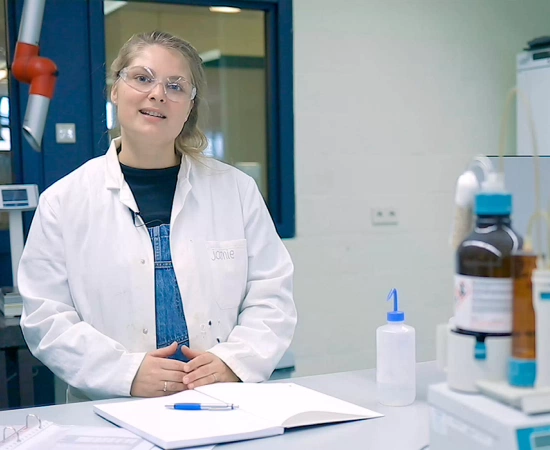
Jamie studentDiscovering the researcher within you.

Wondering what's to come after applying for this programme? Go over the entire admission process.
Please note! If you wish to apply for housing through Fontys, the application deadline is June 15.