

Sprint naar content

Master Digital Technology Engineering (part-time)

Master Digital Technology Engineering (part-time)

Your study programme

Get a good impression of what your study programme will look like.

What will you learn?

At Fontys Pulsed, this 120-ECTS master is built around challenges that come directly from your own organisation. Every semester, you apply what you learn the same week you learn it. Five learning lines shape how you approach every problem you encounter at work.
  • Study while you work. Apply what you learn immediately.

    Every challenge in this master is drawn from your own organisation and role.

  • Master AI, data analytics, IoT and systems engineering.

    Learn on your study day. Apply the next day. See results next week.

  • Graduate in 2 to 3 years at your own pace, with personal coaching.

    A dedicated coach supports your development throughout the programme.

What will your programme look like?

The five learning lines are the lens through which you approach your work, not a timetable to follow. For a detailed description of what each learning line covers, see the master guide.

1. Digital Technologies

You explore how AI, machine learning, IoT and smart embedded systems work, and where they add real value in organisations. You learn to assess technical feasibility, ethical implications and organisational readiness before implementing any solution.

2. Systems Engineering

You learn to structure complex challenges: define the core problem, analyse the current situation, set clear requirements and design scalable solutions that account for human and organisational factors.

3. Design-Based Working

You use design thinking to tackle challenges from a human-centred perspective. Working iteratively, you move from research and problem definition through concept development to practical solutions.

Study load
Five learning lines

Learning lines & Study load

4. Practice-Based Research

You learn to formulate strong design questions, choose the right research methods and validate your outcomes. You apply research ethics throughout, ensuring your solutions are reliable and defensible.

5. Personal and Professional Identity

A dedicated coach supports your development throughout the programme. You reflect on your strengths, grow into a self-directed professional and develop the confidence to lead complex change projects.

Studyload

Approximately 20 hours per week, structured around your working life, on average: 6 hrs lectures & coaching + 6 hrs self-study + 8 hrs project work in your own organisation. Three times per year: a three-day boost session to kick off a new challenge phase.
Year 1
Five learning lines

Year 1. Three challenges. Applied directly in your own organisation

You start by exploring how data from your own organisation can drive better decisions, building and testing a data collection system yourself. Then you design a machine learning algorithm to enhance what your data can do. Your third challenge takes you through a full design cycle for a state-of-the-art digital technology, resulting in a working proof of concept applied in your workplace.
Year 2.
Five learning lines

Year 2. One major challenge and a graduation project in your own organisation.

In Year 2 you take on a challenge at ecosystem level. Connecting your expertise to a broader context like healthcare, smart industry or sustainable technology. Then comes your graduation: 20 weeks in which you define a real design question in your organisation, do the research and deliver something that works.
4 challenges and graduation
Five learning lines

4 challenges and graduation

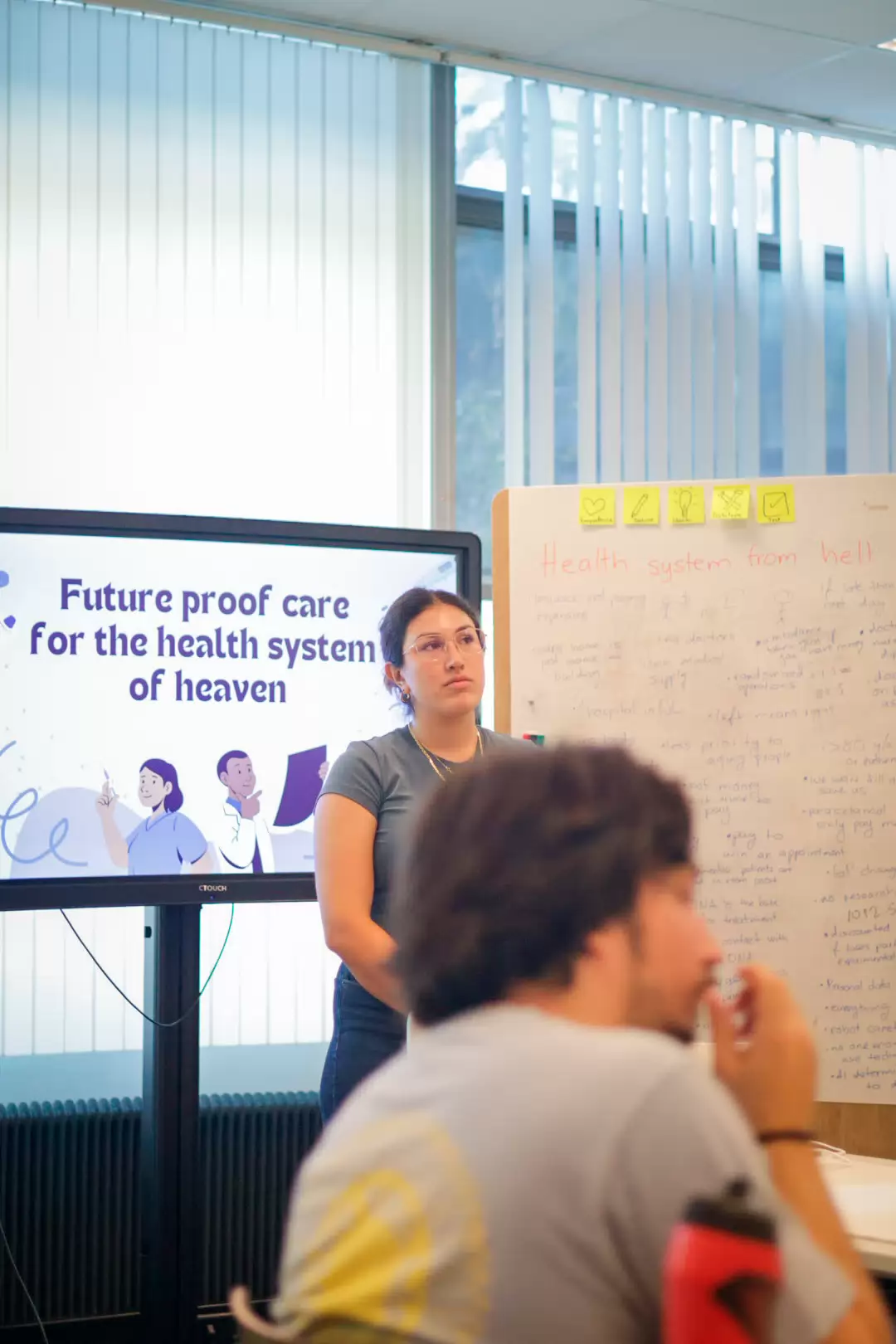
Each challenge is open-ended; there is no single right answer. You work in teams, combine all five learning lines, and present your outcomes to real stakeholders. Complexity increases deliberately each time:

Challenge 1

Individual level. "Me, myself and data": you help a fellow student understand their daily habits through a self-built data collection and visualisation system.

Challenge 2

Group / organisation level (outside). You design a machine learning algorithm to address a real data question in your organisation. You translate digital technology possibilities into practical, sustainable solutions for a professional context.

Challenge 3

Company level (inside). You work inside an organisation, navigating internal culture, stakeholder dynamics and the full complexity of real digital transformation in practice.

Challenge 4

Ecosystem level (outside). Year 2 opens with a big one: a challenge at the level of a whole sector or ecosystem. Think healthcare, smart industry or urban transformation. You combine technology, ethics and design at a scale you haven't worked at before.

Graduation

Ecosystem / company level (your choice). You spend 20 weeks in your own company, working on a real problem from start to finish. You define the question, do the research and deliver something the company can actually use.
Five learning lines

Your lecturers do not just teach. They research.

The master is connected to the research team Systems for Transformation and the lectorate Industrial Engineering and Entrepreneurship at Fontys. Your lecturers work on live questions with real companies, and what they find feeds into your challenges.

As a part-time student, you bring that research into your own organisation every week. The direction goes both ways.
Student experiences

Jordi

Student

The project involved creating a digital dashboard in collaboration with a production facility in Poland, investigating ERP systems, internal processes, and cloud solutions. The concept of Industry 5.0 was integrated as a vision for future manufacturing at Signify.

Willem

Student

I researched how the organization could transition from Robotic Process Automation (RPA) to Hyperautomation, focusing on managing the strategic shift and integrating intelligent technology. The outcome was a Low-Code application that allowed Ciphix's consultancy branch to extract and store client information during consultancy sessions.

Zoë

Student

I started with a bachelor's degree in Health and Technology, specialising in Orthopedic Shoe Technology. During my final year, I discovered that the technical and innovative side of the field was what excited me most. I wanted to keep developing myself, and that is how I found the Master Digital Technology Engineering.

What appealed to me straight away was that this is not a specialised follow-up programme. It is a broadening master. You can develop yourself towards technology, digitalisation or innovation, and across different domains such as healthcare. The assignments are open-ended and you have a lot of freedom to find your own approach. You are truly in the driving seat.

From the very start, you work on real challenges from the professional field. I did my placement at Saasen Groep, which develops emergency response training. But there are many possibilities: fellow students did their placements at organisations like Canon, and we also worked on projects for CSU. You quickly realise you are not working on fictional assignments. You are genuinely in conversation with companies, working on challenges that matter.

In my first year, I was on campus about three days a week. We had guest lectures, worked together a lot and had access to all the facilities to develop and improve our prototypes. Later on, the focus shifts more towards self-study and project work. I combine the master with a role as chair of the CMR, which means it takes me a little longer. But having a part-time job at the weekend is perfectly manageable. It does require a full working week and a lot of personal responsibility.

Sometimes a project does not go as planned. At one point, company data turned out to be difficult to access during a group assignment. You then have to work together with the company and the lecturers to find a way forward. The lecturers are there to support you, but they also expect you to take initiative yourself first. That is exactly where you learn the most.

The biggest change for me is in the way I look at problems. I no longer jump straight to a solution. I first ask why something is actually a problem and whether we are working on the right solution at all. That critical thinking stays with me in everything I do.My bachelor was quite specialised. Thanks to this master, my options have become much broader. I can see myself working in innovation management in healthcare. An ambition that grew precisely during this master.

Not sure whether this master suits you? Just come and meet us. It really does not matter what technical background you have. Every student brings something different, and it is exactly that mix of backgrounds that makes it so valuable.

Check all deadlines

Admission timeline

Wondering what's to come after applying for this programme? Go over the entire admission process.

Please note! If you wish to apply for housing through Fontys, the housing application deadline is June 15.

Master Digital Technology Engineering

Admission timeline

Wondering what's to come after applying for this programme? Check out the entire admission process.

Start in September

  • Start your orientation

    Have you attended a study orientation event already?

    Take a look at our orientation events
  • Application deadline

    International students: 1 June. Dutch students: 31 August.

    Check application process
    Make sure to start the application process as soon as possible.
  • Submit required files

    Submission and assessment of grade lists, diploma and proof of language. For non EEA-students: additional steps can be required.

  • Complete your payment

    The tuition fees indicator helps you to determine the tuition rate for your situation.

    Everything about finances
  • Arrange student housing

    Fontys can offer housing for a limited number of international students. Fill in the housing application form before the deadline (15 June).

    More info about housing
  • End of August

    Get to know Fontys and your fellow students during Purple Introduction week.

    Take a look at your introduction programme
  • 1 September 2026

    Start study programme