
Events


Check all deadlines
Open days and more
A heart monitor, an electric race car, headphones that cancel out noise: they all run on electronics. In Electrical and Electronic Engineering, you learn to design, build and test them. Doesn’t something work the way you planned? Then you measure why and improve your design.
You don’t need to know how to program, solder or design circuit boards yet. You learn all of that step by step during the programme.
Do you want to find out how your phone processes signals and connects wirelessly?
When something doesn’t work, you want to know why and how to fix it.
A device only really works when hardware and software work as one.

How does a smart baby seat notice that a baby is crying? How does a model car find its own way? And how do you send a message through an antenna you built yourself? In Electrical and Electronic Engineering, you learn by designing, building and testing: with circuits, circuit boards, chips and code.
In your very first semester, you and your team build a working prototype.
You use an oscilloscope to track down faults and improve your design.
You regularly discuss your progress with your team and your teacher.
In year 1, you learn the basics of electronics, programming and maths, with plenty of structure and guidance. In year 2, you go deeper into signal processing, power electronics and the software that runs inside devices. In year 3, you do an internship and choose a minor. In year 4, you choose your specialisation and graduate at a company.

Will you design electronics for chip machines? Develop medical equipment or wearable measuring systems? Make sure the light and sound at a festival are spot on? Or work on energy-efficient electronics, such as battery management? Electronics are everywhere, so you have plenty of choice. Or you continue with a master’s.
Make sure to check all admission requirements.
Explore your future at Fontys where you will meet innovation, entrepreneurship, and creativity.
Easily calculate your tuition fees with the tuition fees indicator. Besides tuition fees, you will also need to budget for study materials, a laptop, the introduction programme, and more. Find details about monthly living costs on our Finance page.
All about finances
Starting a study in a foreign country is exciting. Learn more about how Fontys can assist you, especially with accommodation, amid the Dutch housing crisis.
English
September, February
Bachelor
Full-time
4 year(s)
Eindhoven

Wondering what's to come after applying for this programme? Go over the entire admission process.
Please note! If you wish to apply for housing through Fontys, the application deadline is June 15 (start September) or December 8 (start February).
You design electronics, write embedded software (software that runs inside a device) or test whether a system works properly. You could start out as an electronics designer, embedded software engineer or test engineer. Students do their internships and graduation projects at companies such as ASML, NXP and Signify. But you can also work in medical technology, mobility or the energy sector.
You don’t need to know how to program, solder or design circuit boards yet. You learn all of that step by step during the programme. What does matter is an interest in technology, commitment and regular practice. In the first year, we refresh the key topics from maths and physics, and you use them straight away in your assignments. Student Lisanne has one tip for new students: “Make sure you don’t fall behind, because then it gets harder and harder. Do you notice you’re starting to fall behind? Speak up. Teachers are always willing to help you.”
Electrical and Electronic Engineering is about electronics, signals and embedded software, and above all how they work together. ICT focuses more on software, data and digital applications. Take your smartphone: an electrical engineer designs the wireless connection and the audio amplifier, for example. An ICT specialist builds the app you use to listen to music.
Both programmes deal with electronics, software and systems, but with a different focus. In Electrical and Electronic Engineering, you mainly specialise in circuits, signals and embedded software. Mechatronics focuses more on how electronics, software and mechanics work together in systems that move, such as a robot.
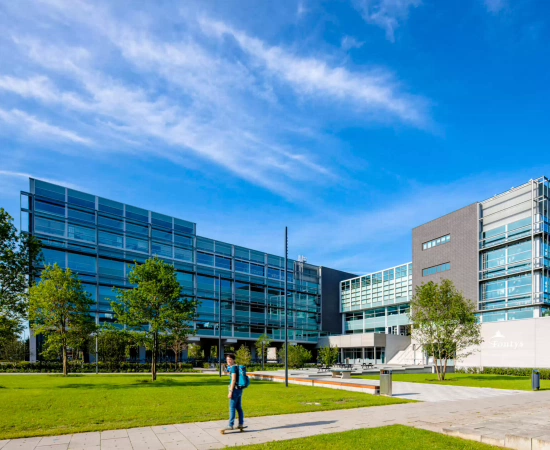
On electronics for smart devices: sensors, circuits, chips and embedded software. You study in Building Nexus on the campus of Eindhoven University of Technology (TU/e), right in the heart of Brainport Eindhoven, one of Europe’s leading high-tech regions. You notice that in your studies: you work on projects with companies, you regularly get guest lectures from people working in the field and you do internships at companies such as Adimec, ASML, NXP and Sioux.
In the Netherlands, you can study engineering at two types of university. Fontys is a university of applied sciences: the focus is on applying, designing and learning through projects. You learn the theory and use it straight away in a working design. At a research university, you usually study technical principles in a more abstract and mathematical way, with more focus on scientific research. Want to go into science after your bachelor’s after all? In the hbo top programme, you can already take courses from the TU/e pre-master’s programme during your minor. That gives you a head start towards a master’s at TU/e.
We are happy to help.