


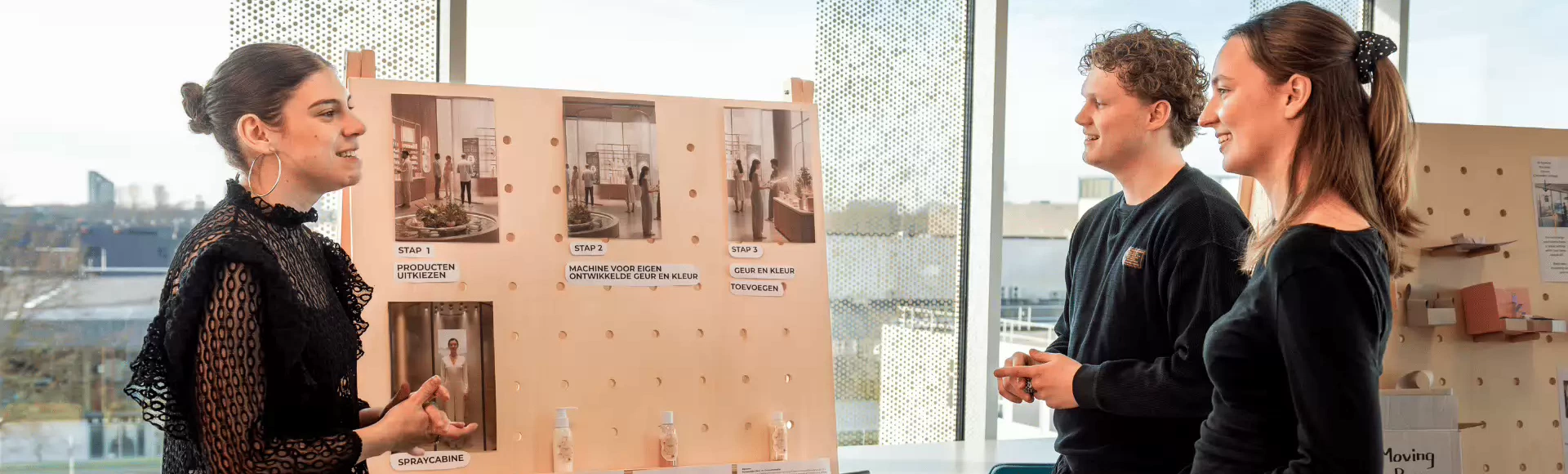
Trend and Future Research
What will TikTok, ChatGPT, or Instagram be up to in five years?
What does the future hold for Nike, Ajax, or Red Bull? And what will happen to brands like Dior, Rituals, or Patagonia, or companies like Heineken, IKEA, and Ahold Delhaize?
About Trend and Future Research
Large organizations in all sectors are constantly thinking about the future, not just out of curiosity, but because their success depends on it. Using trend research and scenario planning, they try to understand what lies ahead so they can respond to change in a smart way.
In this minor, you will learn how future thinking works in practice: how companies use future research to innovate, and how you can learn to work with the future yourself.
Why this programme?
- Learn how to identify trends and translate them into future scenarios.
- Turn trends into strategic opportunities for businesses.
- Develop multidisciplinary thinking and present your ideas creatively.
- Inspiring field trips to innovators.
More about Trend and Future Research
In this minor, you will learn one of the most important skills of the future: looking ahead. You will learn to:
- question your assumptions about what is to come.
- recognize signs of change.
- anticipate the unknown.
In this way, you will develop an open, inquiring view of tomorrow's world and learn to translate this into meaningful strategies for today.
And you do so in a world that is changing faster than ever. Technology, climate, and social shifts are putting existing systems under pressure. Companies, governments, and social organizations are searching for new directions and meaning. In this minor, you will learn how to understand, translate, and visualize such developments.
You will work on real issues faced by companies, governments, and social organizations. This will allow you to discover how your unique perspective as a trend and future thinker can make a difference and develop both your investigative and creative skills.

About the Exchange Program 'Trend and Future Research'
Admission requirements
For each program, the minimum level of English required will equate to the level of IELTS 6.0 (International English Language Testing System) or TOEFL iBT 80 (Test of English as a Foreign Language) or CEFR B2 (Common European Framework of Reference for Languages).
How to apply as an exchange student
Applications should always be submitted via the International Exchange (or Erasmus) Officer at the home university. If several versions of the programme are offered, please indicate for which version you would like to apply to (Programme I, Programme II, Programme III, etc.) This officer will send your application request (nomination) to Fontys. Once Fontys has accepted the application, your Fontys study department will send you a link to a web application called Mobility Online.
Important dates
Deadline for nomination (by partner University): 1 November
Deadline for applying: 15 November
Academy application requirements
A Skype call will be an obligatory requirement for your application procedure for this exchange programme and can influence the acceptance at our Academy. The Skype call will serve as an extra opportunity for you to show us your motivation and level of English, besides this there’s time for questions of the applicant as well.
How will your course programme be recognised by your home university?
Fontys will provide you with a so-called ‘Transcript of Records’, which will clarify the results that you have achieved. Depending on your results, you will receive a maximum of 30 ECTS credits. ECTS credits are recognised throughout Europe. The agreement between your home university and Fontys University of Applied Sciences will usually include a condition whereby the credits that you obtain will be recognised and transferred into the records kept by your home university.
Practical information
- Start moment(s)
- February
- Location
- Tilburg
- ECTs
- 30
- Language
- English
- Duration
- 20 weeks
- Contact hours
- 20 hours per week
Please note that the expenses noted below are estimates only for a semester abroad at Fontys and that the actual expenses will depend on your personal lifestyle. If excursions are included in the curriculum, the costs are for the student him/herself. The study programme is obligated to offer a free option as well. You will receive more information about extra costs if applicable in the course descriptions you’ll receive once accepted to the programme.
Tuition Fees
Students on exchange from Fontys ACE partner universities will not be obliged to pay tuition fees. For all other students, a fee of € 75 per ECTs credit will apply (i.e. a 30 ECTs programme = € 2,250).
Living Expenses
Students can expect general living expenses to amount to approximately € 700 to € 1,000 per month. This amount includes accommodation (i.e. approximately € 500 to € 600 per month all inclusive), food, transport and personal expenses.
Visa Expenses
These costs vary depending on your country of origin. EEA students do not require visas and as such, no expenses will be applicable. Students requiring Entry Visas and/or Residence Permits can expect to pay charges of approximately € 600. Grants In theory, students hailing from the European Union, Norway, Switzerland, Iceland and Turkey may be eligible for Erasmus Study
Grants
Please refer to the International Office at your home university for further information.
It is not always easy for exchange students to find accommodation in the Netherlands. Therefore, Fontys offers a service to provide students with assistance in securing suitable accommodation (i.e. a student room) for their exchange at Fontys. For information go to the Fontys accommodation page.
Application procedure
- After nomination by your university for an exchange programme at the Fontys Academy for the Creative Economy (Fontys ACE) you will be asked to enrol through Mobility Online (our online application system).
- Once you’ve been accepted in Mobility Online you can continue the application steps, including filling in the accommodation form before June 15 (for Fall semester) or December 8 (for Spring semester).
- You can give your preference for a basic student room or a more luxurious student room with services included.
- The accommodation officer will send you detailed information about the housing agency after the housing deadline.
- The housing agency will get in touch with you and you'll have to transfer two months of rent + deposit before arrival to housing agency (no payment = no entrance accommodation, but still the obligation to close rental contract).
- Accommodation is available on the agreed date.
- You are obliged to accept and pay for the offered room for the whole period.
The Netherlands
The Netherlands is a country in western Europe with a multicultural population of approximately 17 million people. It has a very rich history in international trade, education, art, literature, design and sciences. This tiny country is famous for the great Dutch Masters, painters like Rembrandt and Van Gogh, but also pioneers in the EDM scene, such as Tiesto, Armin van Buuren and Martin Garrix. They transformed the world around them just like today’s Masters: designers, concept developers, futurists. The Dutch creative industry of the 21t century is growing rapidly and plays a leading role in strengthening the innovative capacity of the country.
Tilburg
More than 27,000 students study in the city of Tilburg in the south of The Netherlands. 13.5 percent of this city’s 200,000 inhabitants are students. Tilburg has a lot of cafés where you can enjoy student life. Students quickly find their favorite bars/pubs, restaurants and other meeting places. Catching a movie, enjoying the night life, a pop concert, visiting museums or going to the theatre: Tilburg offers a great number of possibilities.
Check out vibrant TilburgFor more detailed information about practical matters, such as financial matters, residence permit, health insurance and accommodation, please click on the button below.